
Your Brand Shows Up on Google. What Do ChatGPT and AI Search Say About It?
“Links are yesterday’s news. AI optimization is what matters now.” You’ve probably heard some version of that from marketing speakers over the past year. But ask them to explain how AI ranks recommendations, and the answer gets vague: “Create useful content, add Schema.org markup, and wait.”
We now have concrete data to put those broad recommendations to the test. Ahrefs compared third-party mentions of 10,000 brands with their presence in AI-generated answers. Semrush and Kevin Indig studied when a website citation is accompanied by a brand mention. And Peec AI investigated where ChatGPT gets the products it displays in its recommendations.
Several useful findings emerge:
- Your own website shouldn’t be the only place people talk about your brand. Ahrefs found a strong correlation between third-party mentions and AI visibility. The strongest relationship was with Reddit threads that rank in Google.
- A citation and a brand mention are different outcomes. An AI system may use your website as a source without naming your company. Or it may name your product without linking to it, leaving that exposure invisible in your referral traffic reports.
- Product recommendations have a connection to Google Shopping. Peec AI matched more than 83% of the products in the ChatGPT carousels it studied to Google’s top 40 organic Shopping results. It also uncovered technical evidence that ChatGPT was using that source.
The picture also varies by industry. In DataForSEO’s study of English-language Google results in the US, AI Overviews appeared for 75% of the finance queries studied, compared with 39% of real estate queries [17]. That’s why checking the questions your buyers actually ask matters more than relying on market-wide averages.
Let’s look at how AI systems use external sources, what that means for your brand, and how to set up ongoing monitoring in A-Parser.
1. Where AI Gets the Information for Its Answers
A buyer asks: “Which CRM should I choose for a small business?” To answer, an AI system can draw on more than what it learned during training. It can also search the web for recent reviews, comparisons, and product pages.
This approach is called retrieval-augmented generation (RAG): the system retrieves relevant material, then uses it to generate an answer. Access to publisher content and the conversation’s context—such as the buyer’s budget or integration requirements—can also affect the result.
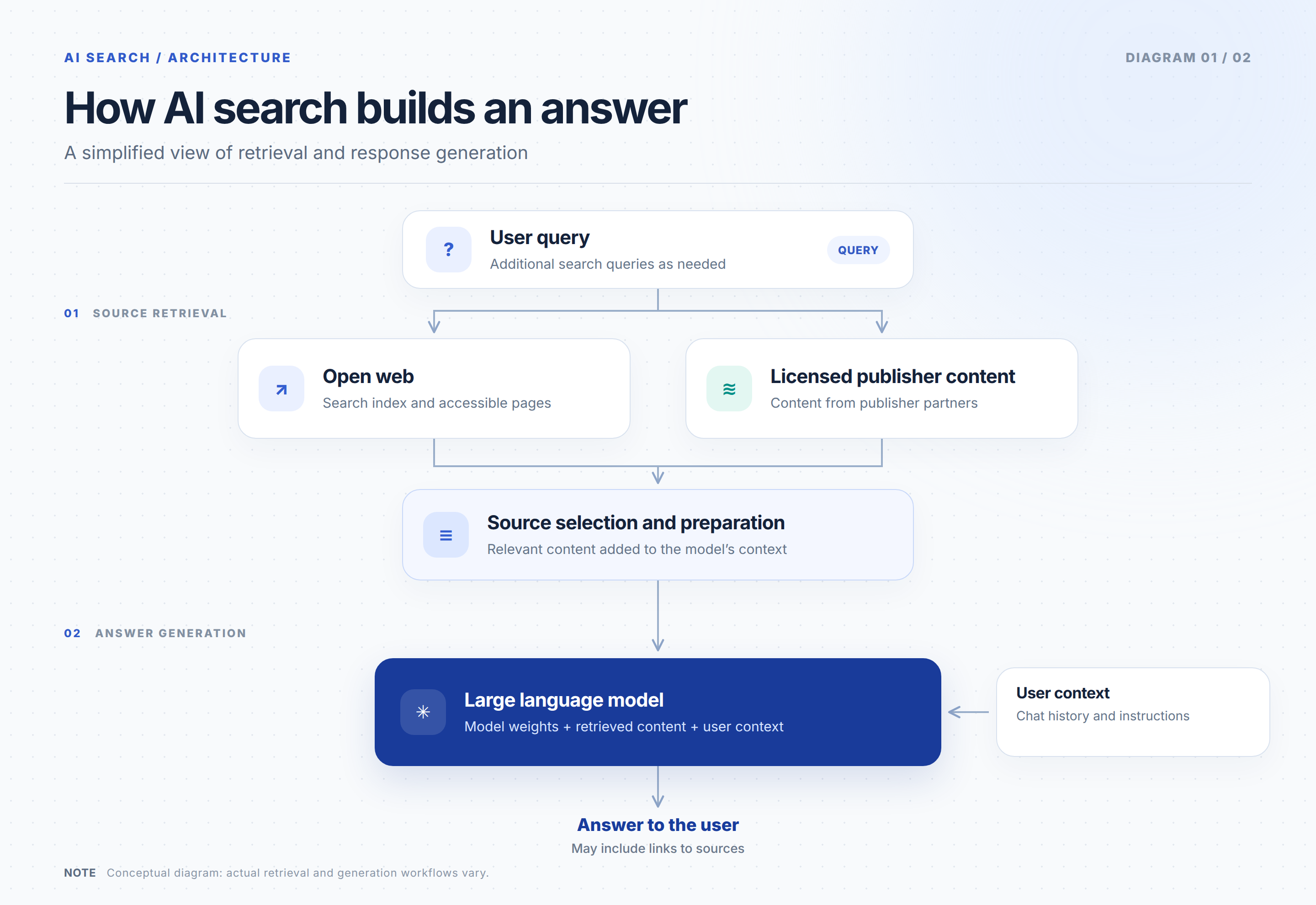
The diagram shows the general principle. Search and source-selection methods vary by service. A single user question can trigger multiple search queries, a process known as query fan-out.
What Information Can Go Into an Answer?
| Information source | What it includes | How it’s used | What it means for your brand |
|---|---|---|---|
| 1. Knowledge learned during training | Website text, books, and other material in the training data. | Builds the model’s knowledge and associations between concepts, including brands and categories. | This isn’t a real-time update channel: new information on your website doesn’t change an already-trained model. |
| 2. Web search | Pages found through search engines and accessible to search crawlers such as OAI-SearchBot. | Helps retrieve current reviews, comparisons, pricing, and specifications. | Your presence in search results and crawlers’ access to relevant pages both matter. |
| 3. Licensed publisher content | Content from partners including Condé Nast, Hearst, Future, and Axel Springer. | May be used in answers, depending on the query and the partnership’s terms. | Check which reviews and comparisons are cited for buyer questions, and whether they include your product. |
| 4. Conversation context | The prompt, earlier messages, custom instructions, and uploaded files. | Defines the task more precisely: budget, industry, required features, and other buying criteria. | Monitor different buying scenarios, not just one broad category question. |
Practical takeaway: Look beyond your own website to the external material AI search cites when answering your buyers’ questions. Is your product included? How is it described, and what is it compared with? This helps you understand what information about your brand an AI system may use in its answers.
2. Who’s Talking About Brands: Reddit, Forums, and Other Platforms
“Mentions are the new links” has become a familiar claim in discussions about AI search. But which types of mentions actually correlate with a brand’s presence in AI-generated answers?
Ahrefs studied 10,000 US brands using a dataset of 260 million non-branded search prompts. It compared how often each brand appeared in answers across three platforms—ChatGPT, Google AI Mode, and AI Overviews—with its presence on third-party sites and platforms [1].
Ahrefs study methodology:
- Sample: 10,000 US brands with names at least five characters long, filtered to remove ambiguous matches with common words and other proper names, plus 260 million non-branded prompts. Prompts containing the brand’s own name were excluded.
- What was measured: Brand mentions on third-party properties the brand does not control, using Ahrefs Content Explorer. The brand’s own website and pages with no traffic were excluded.
- Correlation metric: Spearman’s rank correlation, calculated as a combined measure across all three AI platforms—ChatGPT, AI Mode, and AI Overviews. The closer the value is to 1, the more closely brands’ rankings by third-party mentions align with their rankings by AI visibility.
- The authors’ caveat: Correlation measures how closely the rankings align. It is not an algorithmic weight and does not establish causation. The findings do not show that artificially generating mentions will guarantee more LLM recommendations.
Combined Spearman Correlations by Type of Third-Party Mention
Ahrefs compared seven types of third-party mentions with brands’ combined mention frequency across ChatGPT, Google AI Mode, and AI Overviews:
| Type of third-party brand mention | Spearman correlation |
|---|---|
| Reddit threads that rank in Google | 0.75 |
| Webpage mentions | 0.70 |
| Total traffic of pages mentioning the brand | 0.70 |
| Unique domains mentioning the brand | 0.70 |
| News article mentions | 0.67 |
| YouTube transcript mentions | 0.64 |
| TikTok description and transcript mentions | 0.60 |
Data note: For Reddit, Ahrefs counted threads appearing anywhere in Google search results for the target queries, not just the top 10. Domains, pages, and traffic all had a correlation of 0.70. News article mentions had a slightly weaker correlation with AI visibility (0.67) than mentions across the wider web (0.70).
Comparing Brands: A Nonlinear Relationship With Web Mentions
The study compared third-party webpage mentions with AI mention frequency for the brands in its sample:
| Third-party pages mentioning the brand | Median AI mentions | How the figures compare |
|---|---|---|
| 1,000 pages | ~73 mentions | Baseline for comparison |
| 10,000 pages | ~273 mentions | 10× as many third-party pages, but 3.7× as many AI mentions |
What the numbers show:
Brands at the 10,000-page comparison point had about 273 median AI mentions, versus 73 at the 1,000-page point. In other words, 10 times as many mentioning pages was associated with about 3.7 times as many AI mentions.
The relationship was stronger for Reddit: brands with 10× as many mentions in ranking Reddit threads received 5.5× as many AI mentions on average. The median brand in the study appeared in just eight Reddit threads, and 29% of brands appeared in none.
Why Reddit May Correlate So Strongly With AI Visibility
Ahrefs measured an observed statistical relationship, not the formula behind an AI algorithm. Two potential explanations discussed in the search industry are:
- Direct partnerships: Both Google and OpenAI have commercial agreements with Reddit to use its content for model training and search indexing.
- The value of first-hand experience: With so much programmatic SEO content online, community discussions may help surface real-world experience: users compare alternatives, share what happened when they used a product, and openly discuss its shortcomings.
Why Reddit Data Is Getting Harder to Access
Reddit is restricting unauthorized data collection. In 2026, unauthorized requests to public .json endpoints stopped working [8], and the platform announced that it was discontinuing public RSS feeds [7]. Familiar ways of automatically monitoring discussions may therefore stop working. Check access policies and your tools’ capabilities separately.
Meanwhile, Google and OpenAI have agreements with Reddit for content access. OpenAI, for example, announced access to the Reddit Data API to bring current Reddit content into ChatGPT and other products [9].
What this means for your brand:
Being part of active discussions that rank in search helps buyers find real user experiences. Ahrefs also found a correlation between mentions in those threads and brands’ AI visibility. Monitor relevant discussions and participate in ways that respect each community’s rules.
3. Who ChatGPT Cites: OpenAI’s Publisher and Media Partners
Since 2023, OpenAI has signed agreements with more than 20 publishing groups and organizations, including Condé Nast, Hearst, Future plc, Axel Springer, Vox Media, and the Financial Times [2]. Depending on the terms, ChatGPT can use those publishers’ content and cite it in answers.
Ahrefs tracked how partner sites performed among ChatGPT’s sources. In its analysis of search query fan-outs, those sites’ share of citations among the 200 most-cited domains rose from 7.5% in March 2026 to 15.8% in July, before settling at 12.5% by the end of September [2].
Which Publishers Get Cited Most Often?
Ahrefs examined 85 partner domains. Ten ranked among the top 50 most-cited sites, and 47 made the top 500. The list spans several categories:
| Publisher | Category | Rank among cited sites |
|---|---|---|
| Tom’s Guide | Technology and reviews | 15 |
| Car and Driver | Automotive | 18 |
| TechRadar | Technology and reviews | 24 |
| Wired | Technology and science | 34 |
| The Guardian | News and analysis | 50 |
The Ahrefs Brand Radar data covers ChatGPT answers for US users. News outlets weren’t the only prominent sources: review sites, comparisons, and practical guides also featured heavily.
Citation counts varied dramatically even within the same publishing group. Business Insider, for example, received 16,415 citations, while Politico received 10, even though both belong to Axel Springer.
What Should Your Brand Do With This?
Suppose you sell CRM software. Ask ChatGPT, “Which CRM should I choose for a small business?” Look at the reviews and comparisons it cites. If your product isn’t covered, you could contact the publication’s editors or the reviewer and offer them a chance to test it.
Repeat the check regularly, because the sources in answers change. But finding a relevant publication is only part of the task. You also need to understand what the user actually sees in ChatGPT’s answer: your CRM’s name, a link to your website, both, or neither.
4. Brands, Citations, and Clicks: What Happens in AI Answers
Back to the CRM example. ChatGPT might name your product without linking to your website. Or it might cite a page on your site without mentioning your company in the answer itself.
Suppose someone sees your CRM’s name in an answer, remembers it, and comes back to the decision later. That mention won’t show up in Google Analytics. Analytics records visits to your website, not everything the user read in ChatGPT.
Referral traffic alone doesn’t give you the full picture. You also need to track which websites the AI cites and which brands it names.
How often do citations and mentions diverge? Semrush and Kevin Indig explored that question in The Ghost Citations Study [4].
The researchers analyzed 3,981 brand and domain appearances across 115 commercial and informational prompts in 14 countries on four AI platforms: ChatGPT, Google AI Overviews, Google AI Mode, and Gemini.
They divided the results into three cases: a website citation without a brand mention, a brand mention without a citation, and both together. They call the first case a “ghost citation”: the page appears among the sources, but the answer doesn’t name the brand.
How brands and websites appear in AI answers:
Percentages are based on all recorded appearances of a brand or its website.
| Type of appearance | Share in the study |
|---|---|
| Ghost citation: the website is linked, but the brand isn’t named | 61.7% |
| The brand is named, but its website isn’t linked | 25.1% |
| The brand is named and its website is linked | 13.2% |
The pattern also differs substantially by platform:
- In ChatGPT, 87% of recorded brand/domain appearances included a source citation, but the brand was named in the answer in only 20.7% of cases. Its answers resemble academic writing with a bibliography.
- In Google AI Mode, brands were named in the answer almost twice as often as in ChatGPT. However, a substantial share of links went to third-party aggregators, publishers, and directories.
From a Mention to a Buying Decision
An AI system can name your product in an answer without linking to your website. The buyer may read the comparison, remember the name, and look it up on Google later. Or they may simply add it to their shortlist for now.
That’s why unlinked brand mentions are worth tracking too. They show that your brand can appear in answers to potential buyers, even when those answers generate no referral traffic.
With products, there’s another layer: ChatGPT can do more than name a brand. It can display specific models with photos and prices. For a retailer, that means not just awareness, but having a product included in the shortlist while the customer is deciding what to buy.
5. ChatGPT Shopping: How Products Get Recommended—and Where Google Fits In
A shopper asks ChatGPT to recommend a laptop for work or a coffee maker for home, and gets a selection right in the chat. Product cards may include photos, prices, short descriptions, labels such as “budget pick,” and review summaries.
The shopping experience itself has changed. In March 2026, OpenAI moved away from the early Instant Checkout model, which let users complete purchases inside the chat, and focused on product discovery and selection. Customers complete their purchases with the merchant [5].
That raises a new question for retailers and manufacturers: what helps a product make the shortlist when a shopper is weighing several options? Before looking at product data sources, let’s see which brands ChatGPT users encounter most often.
Ahrefs analyzed 5.5 million ChatGPT answers in the US across a range of topics. Retailers and platforms took six of the top 10 spots among the most-mentioned brands [3]:
- Walmart: named in 95,605 answers (1.73% of all 5.5 million answers).
- Target: named in 52,096 answers (0.94%).
- Apple: named in 45,297 answers (0.82%).
- Amazon: named in 38,795 answers (0.70%).
- The Home Depot: named in 34,876 answers (0.63%).
Retailers appeared frequently in the Ahrefs sample, including in answers about shopping and product selection. But where does ChatGPT get the specific products it recommends?
Google Shopping as a Product Source for ChatGPT
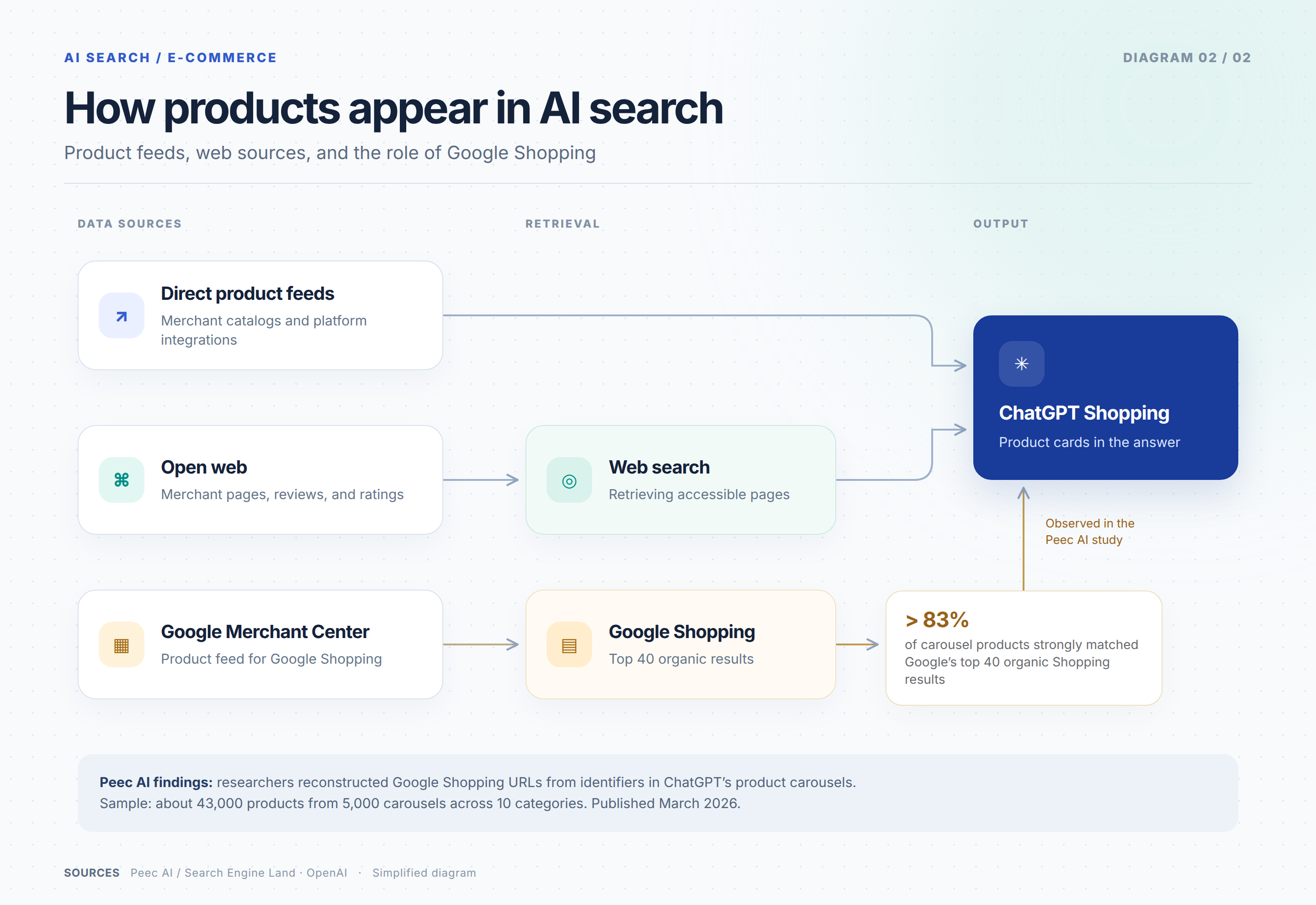
A Peec AI study published in Search Engine Land in March 2026 found more than overlapping product selections. The researchers decoded the id_to_token_map field in ChatGPT’s carousel data. It contained product and offer identifiers (productid and offerid) that let them reconstruct Google Shopping URLs for the same products [14].
They then compared about 43,000 products from 5,000 ChatGPT carousels with the top 40 organic Google Shopping and Bing Shopping results for the corresponding shopping query fan-outs. The study covered 10 product categories and excluded sponsored listings.
More than 83% of the products in ChatGPT’s carousels matched Google’s top 40 Shopping results. For Bing Shopping, the figure was about 11%.
Matches were based on similarity in product titles and brands, allowing for differences in wording. 60% of strong matches appeared in Google’s top 10 Shopping results, and almost 84% appeared in the top 20. The authors concluded that Google Shopping was the main product source for the carousels they studied. Higher-ranking products also tended to appear earlier in ChatGPT’s selections.
An earlier Semrush experiment found a similar pattern: in 75.5% of cases, ChatGPT’s first product recommendation appeared among the top three organic Google Shopping results [15].
Where Does ChatGPT Get Product Data?
The Peec AI study describes how the carousels worked during the period examined. Alongside Google Shopping, OpenAI’s documentation identifies other product data sources:
- Direct product feeds to OpenAI. Merchants can apply to submit their catalogs directly to ChatGPT. A feed provides pricing, availability, and other product attributes. OpenAI also says that Shopify and Etsy catalogs are already integrated [11].
- The merchant’s website. OpenAI explicitly states that a product feed isn’t required if ChatGPT already crawls the site [11]. To make pages accessible to ChatGPT search, the company recommends allowing its
OAI-SearchBotcrawler [16]. - Other sources. ChatGPT also uses data from third-party providers and public sources, such as reviews. These can supplement the merchant’s own data [12].
What Should Online Retailers Do?
Work on your products’ organic visibility in Google Shopping—not just for Google traffic, but also for their potential inclusion in ChatGPT recommendations. That’s the main practical takeaway from the Peec AI study.
Check that OpenAI’s search crawler can access your product pages and that pricing, availability, and specifications are visible on them. Keep the information on your website and in your catalogs consistent. If you plan to submit a direct feed, OpenAI’s documentation explains the requirements [13].
Then regularly check which products appear in answers to your buyers’ questions: yours or your competitors’.
6. How to Build an AI Visibility Workflow
We’ve covered where AI systems find information about brands and products. Now let’s turn to the practical work: which prompts to monitor, what to check on your website, and how to collect results consistently.
Step 1. Collect the Questions Your Buyers Ask
Start with the questions people ask when choosing a product. Find them in customer conversations, sales calls, and search queries. Don’t just check your brand name. Include situations where the buyer doesn’t know about you yet.
Semrush recommends dividing tracked prompts into three groups [6]:
- Core—for consistent comparison. Examples include “Which CRM should a logistics company use?” and “What are the alternatives to HubSpot?” Monitor these regularly to see how your brand’s presence changes relative to competitors.
- Explore—to find new opportunities. Add customer questions and test new scenarios, such as “A CRM for a small team without a dedicated administrator.” This helps you find topics your Core set doesn’t cover.
- Verify—to check whether a result is consistent. Repeat important prompts and compare answers across other AI platforms. This helps you assess whether a result is repeatable or just an isolated answer.
Don’t fill your list with dozens of minor variations on the same wording. Add meaningful buying criteria instead: budget, company size, industry, or a specific use case.
Step 2. Check That Search Crawlers Can Access Your Website
Before working on your presence in AI answers, check whether search crawlers can access the relevant pages. Ask your technical team to review robots.txt, website security settings, and access from crawler IP addresses.
For ChatGPT search, the relevant crawler is OAI-SearchBot; for Perplexity, it’s PerplexityBot. If your website blocks their requests, an allow rule in robots.txt alone won’t fix the problem.
Search access and training permissions are separate settings. For example, you can allow OAI-SearchBot while blocking GPTBot, which collects material for model training [16].
Example robots.txt configuration:
# Allow AI search crawlers
User-agent: OAI-SearchBot
Allow: /

User-agent: PerplexityBot
Allow: /

# Disallow content collection for OpenAI model training
User-agent: GPTBot
Disallow: /
Step 3. Find Discussions and Content About Your Category
Ahrefs found a strong correlation between mentions in ranking Reddit threads and AI visibility. In practice, that’s a reason to look at where buyers are already discussing your category and competitors.
- Find relevant discussions. Check which Reddit threads appear in Google for your target queries. The top 10 results are a useful place to start.
- Bring in your company’s subject matter experts. Have people participate who can answer questions, share real examples, and explain the differences between products. Follow community rules and disclose their connection to your company.
- Review your YouTube captions. Make sure reviews and tutorials accurately transcribe product names, specifications, and explanations. That makes the video’s content easier to understand for viewers and for systems that work with its transcript.
Step 4. Set Up Recurring Data Collection in A-Parser
You can check a few prompts manually. Once the list grows and you need to compare answers over time, automated collection is more practical. You can use a dedicated monitoring service or set up your own workflow in A-Parser.
Two approaches to ongoing AI monitoring:
| Consideration | Cloud-based SaaS platforms | Your own A-Parser workflow |
|---|---|---|
| Pricing | Usually a subscription with plan limits | A perpetual license; proxies and infrastructure cost extra |
| Scaling the number of checks | May require a more expensive plan | No per-request A-Parser fee; costs depend on resources and traffic |
| Results | Ready-made reports; raw data access varies by service | Answer text and source links for your own analysis |
| Setup and maintenance | The service handles most technical tasks | You manage collection settings, proxies, and result processing |
Built-In A-Parser Parsers for Monitoring
A-Parser includes built-in parsers for search results, AI-generated answers, and Reddit discussions:
 SE::Google and
 SE::Google::Modern—AI Overviews and product carousels:
- These parsers collect more than standard search result links. They also extract the AI Overview block: answer text, block type, interactive snippets, source links, and anchor text.
- They also collect People Also Ask blocks and Google Shopping product carousels, letting you compare products in Google with ChatGPT’s recommendations.
 FreeAI::ChatGPT—direct collection of ChatGPT answers:
- Collects answer text and source links from ChatGPT’s web interface without token charges. You can use that data to check which brands are named and in what context.
 FreeAI::GoogleAI—Google AI Mode monitoring:
- Collects Google AI Mode answer text and source links with anchor text, so you can see which brands are named and which websites are cited.
 FreeAI::Perplexity—Perplexity answer monitoring:
- Collects answer text, cited sources, and Related Questions.
 Reddit::Posts and
 Reddit::Comments—Reddit discussions:
- Collect posts and comments by keyword to monitor discussions about your product and competitors. Use search parsers to check where those threads rank in Google.
Promotion available through the end of November 2026: use promo code FESTIVAL11 for 30% off perpetual A-Parser licenses for new users and Premium Mix residential proxy packages. Apply the code on the A-Parser purchase page or in the Premium Mix section. See the official promotion thread for details [10].
From Data Collection to Reporting
Load your prompt list, configure the parsers and proxies, and collect AI search answers along with their source links. Export the results to a spreadsheet for analysis: which brands are mentioned, which websites are cited, and how the answers change over time.
Conclusion
A buyer may first discover your product in an AI-generated answer—not on your website or on a search results page. Your brand might be named without a link. That mention won’t appear in referral traffic reports, but the buyer can remember the name and look it up later.
That’s why AI visibility work extends beyond your own website. You need to understand what reviews and discussions say about your product, which sources are cited for buyer questions, and which products make it into recommendations.
Start with a list of your audience’s questions and check the answers regularly: is your brand there, what does the answer say about it, and who gets recommended instead? That will help you see where to update information on your website, contact a reviewer, or investigate why competitors are making the shortlist.
Sources and References
- Ahrefs Research (November 2026): Louise Linehan. Which Types of Mentions Correlate the Strongest With AI Visibility? (260M AI Prompts Analyzed)
- Ahrefs Research (November 2026): Ryan Law. Every OpenAI Publisher Partnership, and How Often ChatGPT Cites Them
- Ahrefs Research (November 2026): Si Quan Ong. The 100 Most Mentioned Brands in ChatGPT (November 2026)
- Semrush (June 9, 2026): Margarita Loktionova. Why 62% of AI Citations Don’t Lead to Brand Mentions
- Semrush (November 2026): Zach Paruch. How to Optimize for ChatGPT Shopping
- Semrush (November 2026): Carlos Silva. Prompt Tracking Methodology to Measure AI Visibility
- Reddit: Continuing our infrastructure updates
- The Data Collector (June 10, 2026): What Changed in Web Data: May 2026 Recap
- OpenAI and Reddit (May 2024): OpenAI and Reddit Partnership
- A-Parser: 11.11: Get 30% OFF A-Parser and Premium Mix
- OpenAI: Power product discovery in ChatGPT
- OpenAI Help Center: Shopping with ChatGPT Search
- OpenAI Developers: Submit product feeds
- Peec AI / Search Engine Land (March 5, 2026): Tom Wells. New finding: ChatGPT sources 83% of its carousel products from Google Shopping via shopping query fan-outs
- Semrush (January 20, 2026): Leigh McKenzie. ChatGPT Searches Google Shopping to Create its Recommendations
- OpenAI Developers: Overview of OpenAI Crawlers
- DataForSEO (November 11, 2026): Google SERP Features By Industry: 2026 Trends & Key Changes