Query Formatting
Query format - allows adding substitutions and formatting the query to the desired form using templates, applied to each query.
Query formats
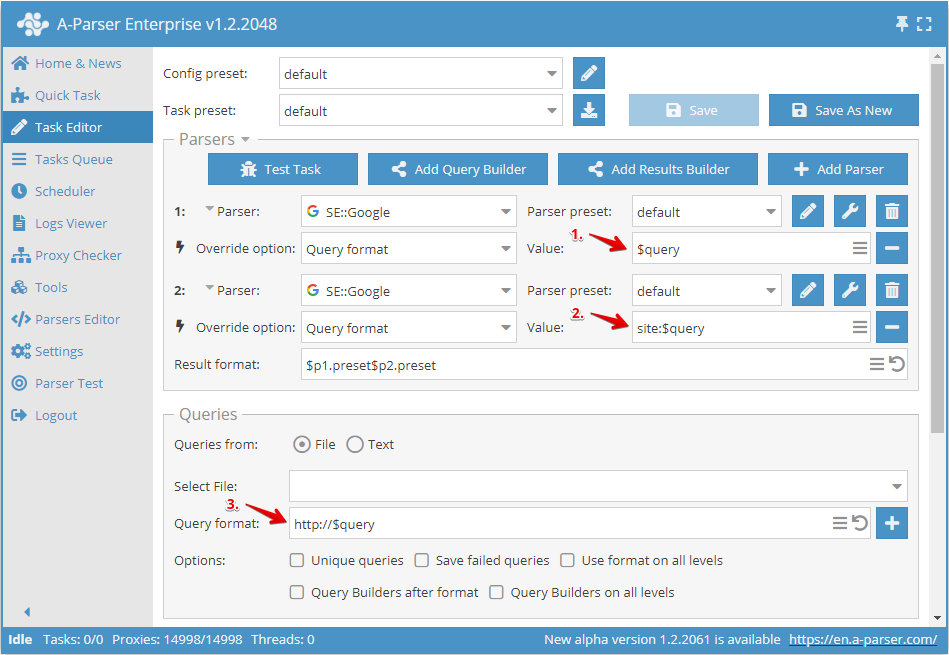
- Query format for the 1st scraper
- Query format for the 2nd scraper
- Common query format
There are 2 ways to specify a template:
- Common query format, it is processed first and supports substitutions
- Query format for each scraper - allows setting a specific format for individual scrapers
Let's look at the example in the screenshot, assuming that we use a file with a list of domains of this type as queries:
google.com
a-parser.com
yandex.ru
The common query format is set as:
http://$query
Before each original query (domain), the string http:// will be prepended, the query will be transformed google.com -> http://google.com
The query format for the 1st scraper remained unchanged, it will scrape the query http://google.com
The query format for the 2nd scraper looks as follows:
site:$query
The query for this scraper will be transformed: http://google.com -> site:http://google.com
Query templates
The query format fully supports the Template Toolkit engine, the following variables are available:
$query- the query after formatting via the common query format$query.num- the sequence number of the query$query.lvl- the nesting level of the query when using the Parse to level or Parse all results options$query.orig- the original query before formatting$query.first- the first query when using the Parse to level or Parse all results options$query.prev- shows the query that was on the previous level, works for HTML::LinkExtractor, $tools.query.add and JS scrapers this.query.add
- All variables created via the Query Builder
Substitution macros
Common query format supports the following macros:
| Macro | Description | Examples |
|---|---|---|
| {az:START:END} | Substitution of an alphanumeric sequence. Instead of START, the beginning of the sequence is specified, instead of END - the end. The length of END must be greater than or equal to the length of START. Characters at the end of the END sequence must be after (in alphabetical order) characters at the beginning of the START sequence. Any UTF-8 character sequences can be used | {az:a:z} - substitution of all characters from a to z (a, b, c, ..., x, z). {az:aaa:zzz} - substitution of all characters from aaa to zzz (aaa, aab, aac, ..., zzx, zzz). {az:a:zz} - substitution of all characters from a to zz (a, b, c, ... aa, ab, ..., zx, zz). {az:00:99} - substitution of all numbers from 00 to 99 (00, 01, 02, ..., 98, 99). {az:а:яяя} - substitution of all Cyrillic characters from а to яяя (а, б, ... аа, аб, ... яяю, яяя) |
| {each:WORD1,WORD2,...} | Substitution of specified words WORD1, WORD2, etc., length is unlimited | {each:green,blue,red,black} - substitution of words green, blue, red, black. {each:,buy,sell} - substitution of an empty word, then buy and sell |
| {subs:NAME} | Substitution of additional words from files in the queries/subs/ folder. Instead of NAME, you must specify the file name without the .txt extension | {subs:zones} - substitution of all lines from the file queries/subs/zones.txt |
| {num:START:END} | The macro iterates through numbers in the specified range. Instead of START, the start of the interval is specified, instead of END - the end. Fractional numbers are supported. | {num:1:1000} - substitution of all numbers from 1 to 1000 (1, 2, 3 ..., 999, 1000) |
| {num:START:END:STEP} | The macro iterates through numbers in the specified range with a specified step. Instead of START, the start of the interval is specified, instead of END - the end, instead of STEP - the step. Fractional numbers are supported. | {num:0:1000:10} - substitution of all numbers from 0 to 1000 with a step of 10 (0, 10, 20 ..., 990, 1000) |
| {num:END:START} | The macro iterates through numbers in the specified range in reverse order. Instead of END - the end of the interval is specified, START specifies the start of the interval. Fractional numbers are supported. | {num:1000:1} - substitution of all numbers from 1000 to 1 (1000, 999, 998, ..., 2, 1) |
| {num:END:START:STEP} | The macro iterates through numbers in the specified range in reverse order with a specified step. Instead of END - the end of the interval is specified, START specifies the start of the interval, instead of STEP - the step. Fractional numbers are supported. | {num:1000:1:10} - substitution of all numbers from 1000 to 1 with a step of 10 (1000, 990, 980, ..., 10, 1) |
⏩ Video: Substitution macros
This video covers:
- the
{num}macro in examples of paging and iterating through coordinates in the Maps::Google scraper
 - the
{az}macro using the example of scraping with inurl: to increase the number of queries and, accordingly, results - the
{each}macro using the example of scraping suggestions to generate word combinations
Combining substitution macros
Substitution macros can be combined. Complex example:
$query site:{subs:zones} {az:aa:zz}
Suppose one of the queries for scraping was viagra, and the file queries/subs/zones.txt contains the following list of zones: com, net, org, then the following set of combinations will be sent for scraping:
viagra site:com ab
...
viagra site:net jj
...
viagra site:eek.rg zz
The total number of queries will correspond to the multiplication of possible combinations:
1 query (viagra) x 3 zones ({subs:zones}) x 676 character variations ({az:aa:zz}) = 2028 queries