 SE::Google::Trends::Suggest - Google Trends search suggestions scraper
Overview of the scraper
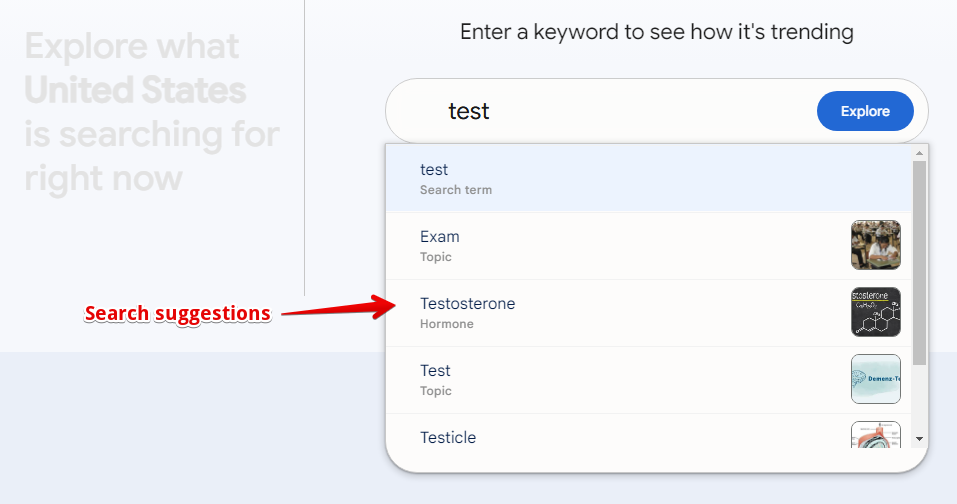
Google Trends keyword suggestion scraper. The Google Trends suggestion scraper solves one of the main SEO tasks, namely the fast automated acquisition of an expanded semantic core. Thanks to the SE::Google::Trends::Suggest scraper, you will be able to automatically collect keyword databases from Google Trends suggestions by query. Using the SE::Google::Trends::Suggest scraper, you can easily and quickly scrape Google Trends suggestions by query.
Thanks to the multithreading of A-Parser, the query processing speed can reach 2000 queries per minute, which on average allows obtaining up to 10000 results per minute.
You can use automatic query multiplication, substitution of subqueries from files, permutation of alphanumeric combinations and lists to obtain the maximum possible number of results. Using results filtering you can immediately clean the result by removing all unnecessary garbage (using negative keywords).
A-Parser functionality allows saving SE::Google::Trends::Suggest scraper scraping settings for further use (presets), setting scraping schedules, and much more.
Saving results is possible in the form and structure you need, thanks to the built-in powerful template engine Template Toolkit which allows applying additional logic to results and outputting data in various formats, including JSON, SQL, and CSV.
Collected data
- Suggestions for the query
- suggestion
- suggestion description (its type)
- link to image
- topic ID
Use Cases
- Collection of keyword databases
Queries
As queries, you must specify search phrases, for example:
write essay
Football
Waterfall
Speak in english
Cats and dogs
forex
cheap essay
Query substitutions
You can use built-in macros for automatic substitution of subqueries from files, for example, we want to add a list of other words to each query, let's specify several main queries:
essay
article
thesis
In the query format, we will specify a macro for substituting additional words from the file Keywords.txt, this method allows increasing query variability manifold:
{subs:Keywords} $query
This macro will create as many additional queries as there are in the file for each original search query, which in total will give [number of original queries(domains)] x [number of queries in the Keywords file] = [total number of queries] as a result of the macro's work.
For example, if the file Keywords.txt contains:
buy
cheap
As a result, the substitution macro will turn 3 main queries into 6:
buy essay
cheap essay
buy article
cheap article
buy thesis
cheap thesis
Output results examples
A-Parser supports flexible result formatting thanks to the built-in template engine Template Toolkit, which allows it to output results in arbitrary form, as well as in structured form, for example CSV or JSON
Exporting the list of suggestions
Same as in SE::Google::Suggest.
Output to CSV table
Same as in SE::Google::Suggest.
Saving in SQL format
Result format:
[% FOREACH results;
    "INSERT INTO serp VALUES('" _ query _ "', '";   suggest _ "')\n";
END %]
Result example:
INSERT INTO serp VALUES('write essay', 'Exam')
INSERT INTO serp VALUES('write essay', 'Testosterone')
INSERT INTO serp VALUES('write essay', 'Test')
INSERT INTO serp VALUES('write essay', 'Testicle')
INSERT INTO serp VALUES('write essay', 'TestNav')
...
Dump results to JSON
Same as in SE::Google::Suggest.
Results processing
A-Parser allows processing results directly during scraping, in this section we have provided the most popular cases for the SE::Google::Trends::Suggest scraper
Results filtering (using negative keywords)
Same as in SE::Google::Suggest.
Possible settings
| Parameter name | Default value | Description |
|---|---|---|
| Language | English | Language selection |