 SE::Bing::Position - Website position checker for Bing
Scraper Overview
A scraper for checking website rankings by keywords in Bing. Thanks to the SE::Bing::Position scraper, you can automatically check rankings in Bing search results using your own domain databases. Using the SE::Bing::Position scraper, you can easily, accurately, and quickly determine a website's position in Bing.
A-Parser functionality allows you to save SE::Bing::Position scraping settings for future use (presets), set scraping schedules, and much more. You can use automatic substitution of sub-queries from files.
Saving results is possible in any form and structure you need, thanks to the built-in powerful Template Toolkit templating engine, which allows you to apply additional logic to the results and output data in various formats, including JSON, SQL, and CSV.
Collected data
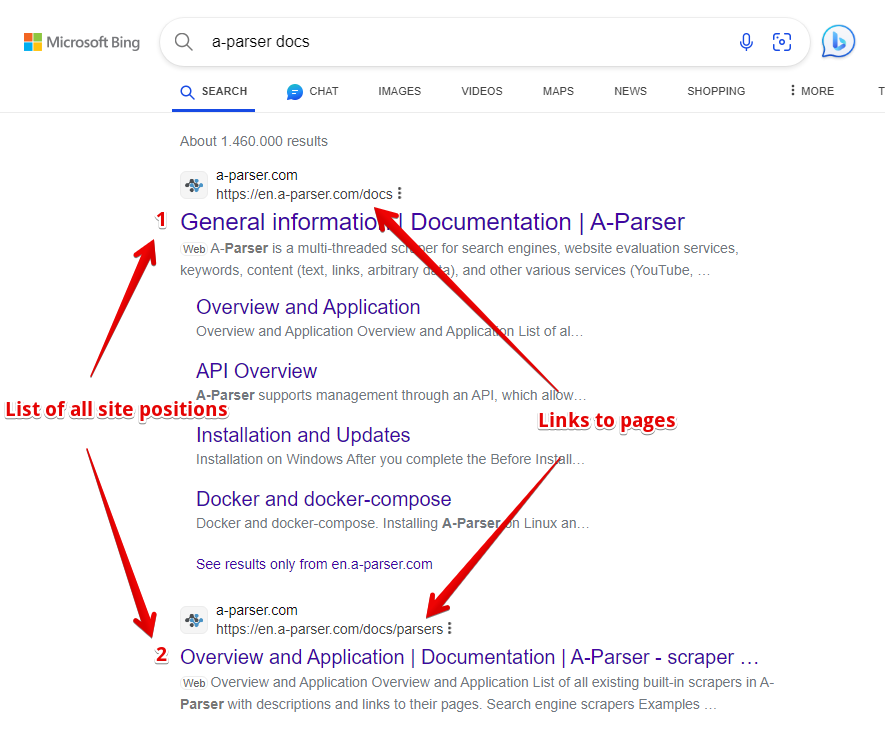
- Website position and the link to the website page
- List of all website positions and page links
Capabilities
- All features of
 SE::Bing
 - Automatically stops scraping when the website is found
- Supports subdomain search
- Ability to compare the searched position by domain, by main domain, and by full link
- Collection of positions for multiple domains at once
Use Cases
- Checking rankings of your own websites and competitors' websites
- Searching for high-traffic website pages
Queries
As queries, you must specify the domain of the searched website and the search query separated by a space, for example:
lenta.ru news
lenta.ru news online
If you need to check one website against a list of queries, you can specify the domain in the Query format:
lenta.ru $query
Or just use a list of keywords. To use multiple domains in a query at once, you need to specify a list of domains separated by commas and the keyword after a space, for example:
lenta.ru,ria.ru,notfound.com news feed
Results will be recorded in the $bulkcheck array.
The Stop when found option is also supported; scraping will end if positions are found for all domains.
Query Substitutions
You can use built-in macros for automatic substitution of sub-queries from files; for example, if we want to check websites/a website against a key database, we specify several main queries:
ria.ru
lenta.ru
rbc.ru
yandex.ru
In the query format, we specify a substitution macro for additional words from the Keywords.txt file; this method allows checking a database of websites against a database of keys and getting positions as a result:
$query {subs:Keywords}
This macro will create as many additional queries as there are in the file for each original search query, which in total will give [number of original queries (domains)] x [number of queries in the Keywords file] = [total number of queries] as a result of the macro's operation.
Output results examples
A-Parser supports flexible result formatting thanks to the built-in Template Toolkit templating engine, which allows it to output results in arbitrary form, as well as in structured formats like CSV or JSON
Exporting the list of positions
Same as in SE::Google::Position.
Simultaneous check of several domains (bulk check)
Same as in SE::Google::Position.
Links + anchors + snippets with position output
Outputting links, anchors, and snippets to a CSV table
Saving related keywords
Keyword competition
Checking link indexing
Saving in SQL format
Result dump to JSON
Results processing
A-Parser allows processing results directly during scraping; in this section, we have listed the most popular cases for the SE::Bing::Position scraper
Saving domains without zero positions
Same as in SE::Google::Position.
Link deduplication
Link deduplication by domain
Extracting domains
Removing tags from anchors and snippets
Filtering links by inclusion
Possible settings
Supports all settings of the SE::Bing scraper, as well as additionally:
| Parameter name | Default value | Description |
|---|---|---|
| Pages count | 1 | Number of search result pages to scrape (from 1 to 50) |
| Links per page | Auto | Number of links in search results per page (Auto / 10 / 15 / 30 / 50) |
| Result format | $domain - $key: $position\n | Result output format |
| Stop when found | ☑ | Stop scraping if the domain is found; will not proceed to subsequent pages |
| Match type | Exact domain | Ability to compare the searched position by domain, by main domain, and by full link (Exact domain / Top level domain / Exact url) |