 SE::Yandex::WordStat::ByDate - Yandex WordStat impression statistics scraper by month or week
Scraper overview
Wordstat is a Yandex service designed to assess user interest in various topics and select keywords for SEO optimization and contextual advertising. Additionally, with Wordstat Yandex, you can evaluate the seasonality and geographical dependence of search queries.
The Yandex WordStat by date scraper supports automatic query multiplication, so you can be sure to get the maximum number of results from the output. Also, A-Parser can automatically follow related queries to a specified depth.
A-Parser functionality allows you to save scraping settings for future use (presets), set a scraping schedule, and much more. You can use automatic query multiplication, substitution of subqueries from files, enumeration of alphanumeric combinations and lists to obtain the maximum possible number of results.
Saving results is possible in the form and structure you need, thanks to the built-in powerful Template Toolkit which allows you to apply additional logic to the results and output data in various formats, including JSON, SQL, and CSV.
Scraper use cases
🔗 Wordstat bydate automation
Used to store up-to-date information in the database, and generates a csv with fresh data on each run
Accounts
To operate the  SE::Yandex::WordStat::ByDate scraper, Yandex accounts are required. Accounts can be registered using the
  SE::Yandex::Register scraper or simply by adding existing accounts to the file
 files/SE-Yandex/accounts.txt in the supported format.
Alternatively, you can enable "on-the-fly" account registration.
Collected data
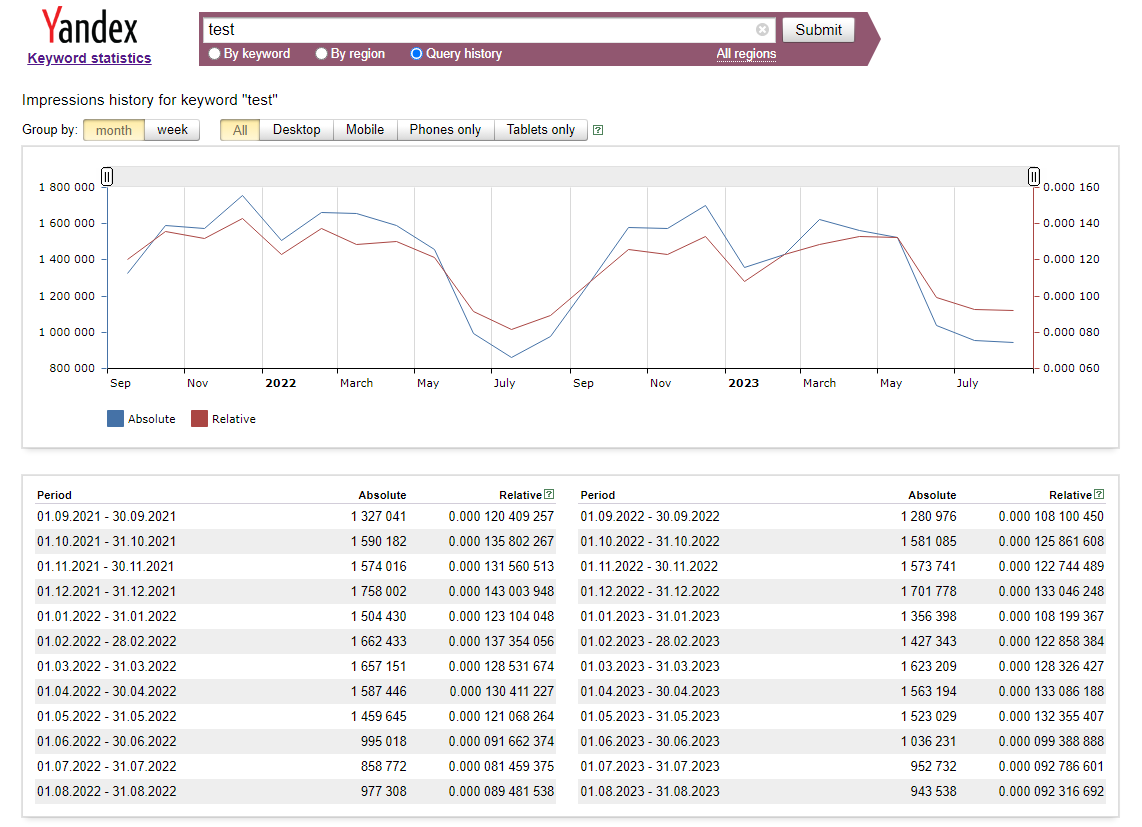
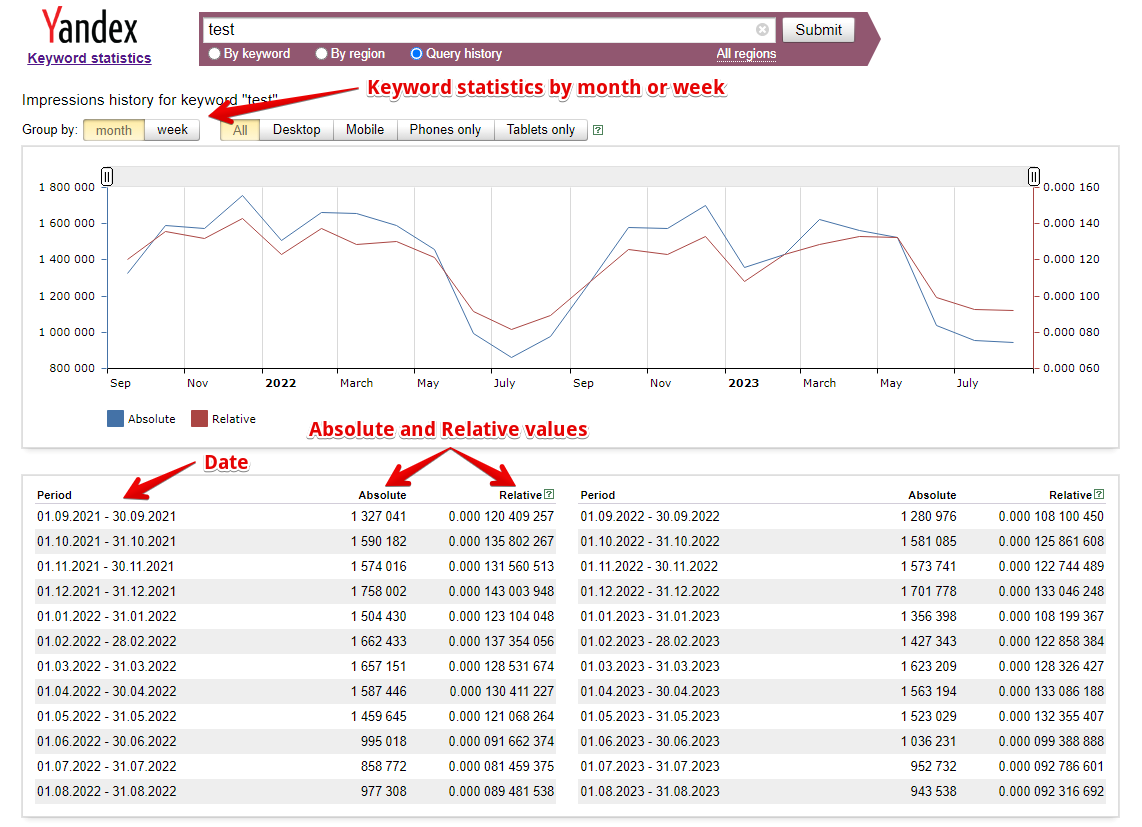
- Keyword statistics by month or week
- Date
- Absolute value
- Relative value
Capabilities
- Supports search region selection (with subgroups)
- Ability to select multiple regions for evaluation at once
- Support for automatic bypass of Smart captcha and the ability to bypass graphical captcha using the AntiCaptcha service or any other supporting their API
- Device type selection
- Ability to choose the authorization method
- Ability to register accounts "on the fly"
- Supports working with extended account format and can answer the secret question (if the answer is in
info). It also uses a saved proxy for authorization (if it is ininfo).
Usage scenarios
- Estimating traffic volume by keyword
- Identifying seasonal keywords
Queries
Keywords should be specified as queries, just as if they were entered directly into the Wordstat search form, for example:
test
Result output options
A-Parser supports flexible result formatting thanks to the built-in Template Toolkit, which allows it to output results in an arbitrary form, as well as in a structured one, such as CSV or JSON
Default output
Result format:
Views:\n$views.format('$date $count $relcount\n')
The result displays keyword statistics for the month and for the week:
Monthly:
2011-09-30 3010832 0.0008903808
2011-10-31 681432 0.0001825883
2011-11-30 628532 0.0001575008
2011-12-31 629072 0.0001495699
2012-01-31 561206 0.0001300651
2012-02-29 572039 0.0001290000
2012-03-31 614897 0.0001225754
2012-04-30 520433 0.0001185340
2012-05-31 521967 0.0001235327
2012-06-30 502568 0.0001299958
...
Weekly:
2012-09-16 118715 0.0001222877
2012-09-23 120799 0.0001211773
2012-09-30 137809 0.0001365837
2012-10-07 133929 0.0001313643
2012-10-14 140373 0.0001293922
2012-10-21 136014 0.0001242209
2012-10-28 148350 0.0001293328
2012-11-04 139556 0.0001232566
2012-11-11 154830 0.0001314057
2012-11-18 136458 0.0001147489
2012-11-25 149463 0.0001261401
2012-12-02 144724 0.0001197564
2012-12-09 149142 0.0001212195
2012-12-16 162864 0.0001298181
Output to CSV table
Result format:
[% FOREACH i IN views;
 tools.CSVline(query, i.count, i.date);
END %]
Example result:
"test",9661734,2012-03-31
"test",8567243,2012-04-30
"test",9028986,2012-05-31
"test",6082099,2012-06-30
"test",5531950,2012-07-31
"test",5214663,2012-08-31
"test",6603865,2012-09-30
"test",9127457,2012-10-31
"test",9238652,2012-11-30
Saving in SQL format
Result format:
[% FOREACH i IN views;
  "INSERT INTO views VALUES('" _ query _ "', '";    i.count _ "', '"; i.relcount _ "', '";  i.date _ "')\n";
END %]
Example result:
INSERT INTO serp VALUES('test', '9661734', '0.0019259985', '2012-03-31')
INSERT INTO serp VALUES('test', '8567243', '0.0019512785', '2012-04-30')
INSERT INTO serp VALUES('test', '9028986', '0.0021368683', '2012-05-31')
INSERT INTO serp VALUES('test', '6082099', '0.0015732140', '2012-06-30')
INSERT INTO serp VALUES('test', '5531950', '0.0013160071', '2012-07-31')
INSERT INTO serp VALUES('test', '5214663', '0.0013327945', '2012-08-31')
INSERT INTO serp VALUES('test', '6603865', '0.0015936909', '2012-09-30')
INSERT INTO serp VALUES('test', '9127457', '0.0018740506', '2012-10-31')
INSERT INTO serp VALUES('test', '9238652', '0.0018308715', '2012-11-30')
Dump results to JSON
Common result format:
[% IF notFirst;
  ",\n";
ELSE;
  notFirst = 1;
END;

obj = {};
obj.views = [];

FOREACH item IN p1.views;
    obj.views.push({
        date = item.date
        relcount = item.relcount
        count = item.count
    });
END;

obj.json %]
Initial text:
[
Final text:
]
Example result:
[{
    "views": [
        {
            "count": "9661734",
            "date": "2012-03-31",
            "relcount": "0.0019259985"
        },
        {
            "count": "8567243",
            "date": "2012-04-30",
            "relcount": "0.0019512785"
        },
        {
            "count": "9028986",
            "date": "2012-05-31",
            "relcount": "0.0021368683"
        }
    ]
}]
See also: Results filters
Possible settings
| Parameter | Default value | Description |
|---|---|---|
| Period | Monthly | Period selection (Monthly/Weekly/Daily, Daily only works with the Use Wordstat 2 option enabled) |
| Start date | | Specifying the date from which to search. Only works with the Use Wordstat 2 option enabled. Be sure to consider the date specification rules |
| End date | | Specifying the date until which to search. Only works with the Use Wordstat 2 option enabled. Be sure to consider the date specification rules |
| Region | All | Search region |
| AntiGate preset | default | You must first configure the  Util::AntiGate scraper - specify your access key and other parameters, then select the created preset here Util::AntiGate scraper - specify your access key and other parameters, then select the created preset here |
| AntiGate preset for Login | default | AntiGate preset for login. You must first configure the Util::AntiGate scraper with parameters, then select the created preset here |
| Type | All | Device type selection |
| Accounts | Only from "accounts.txt" | Selection of the method for working with accounts: Always auto register - always automatically register accounts "on the fly", you need to select a configured preset in the SE::Yandex::Register preset parameter. Auto register if no more in "accounts.txt" - existing accounts from accounts.txt are used first, and if they run out - automatic registration "on the fly" is used, for which you accordingly need to select a configured preset in the SE::Yandex::Register preset parameter. Only from "accounts.txt" - use only existing accounts from accounts.txt, and if they run out - wait for a specified time (Wait new accounts in "accounts.txt" parameter) for new ones to appear |
| Wait new accounts in "accounts.txt" | 0 | Waiting time for new accounts to appear in accounts.txt |
| Remove bad accounts | Always, except wrong login/password | Automatic removal of "bad" accounts: Always - always remove. Always, except wrong login/password - always remove, except when Yandex reported that an incorrect login/password was specified. The fact is that Yandex can give such a message when an IP is banned for an absolutely working account, so optionally you can leave such accounts for reuse. Never - never remove. Regardless of the selected option, accounts are not removed in case of proxy/browser errors |
| SE::Yandex::Register preset | default | Selection of the settings preset for SE::Yandex::Register |
| Authorization method | HTTP | Authorization method: HTTP - fast, not resource-intensive. Chrome - slow, resource-intensive, theoretically can extend account life |
| Chrome headless | ☑ | If the option is enabled, the browser will not be displayed |
| Use sessions | ☑ | Use of sessions |
| Do not reset session if authorization passed | ☑ | Do not reset the session on errors if the scraper is already authorized |
| Use Wordstat 2 | ☐ | Use of Wordstat 2 |
| Wordstat 2 parse all table data | ☑ | Allows you to immediately download all 2000 results for a query without going through pagination |